Friday, June 8, 2012

The Netherlands School Vacation Schedule 2012

The Netherlands is a small country, there is no disputing that. To lower the congestion and crowds during the summer school break the government divided the country into three zones: Nord Nederland, Midden Nederland, and Zuid Nederland (North, Middle, and South Netherlands). Each of these zones takes its summer school holiday on different schedules. So only one third of the country is on holiday at any given time, although there is some over lap.

This system gives you the opportunity to plan your vacation around your Dutch hosts.It also greatly impacts driving. During the Zuid Nederland school holiday period my drive to Weert every day is much easier because there are fewer cars on the road; they are all off on vacation.

The schedule rotates every year so each zone gets to have the different weeks of the summer off. So, what is the schedule this year?

 Zomervakantie 2012 - Nederland

Primary (Elementary) School:

North Netherlands               21 Jul 2012 t/m  2 Sep 2012   
Middle Netherlands             7 Jul 2012 t/m    19 Aug 2012   
South Netherlands               30 Jun 2012 t/m 12 Aug 2012   

Middle and High School:

North Netherlands               14 Jul 2012 t/m   2 Sep 2012
Middle Netherlands              7 Jul 2012 t/m    26 Aug 2012   
South Netherlands                30 Jun 2012 t/m 19 Aug 2012

The North Region consists of the following Provinces:
  • Groningen
  • Friesland
  • Drente
  • Overijssel
  • Noord-Holland
  • Flevoland (met uitzondering van Zeewolde)
  • Gelderland: Alleen (only) Hattem
  • Utrecht: Alleen (only) Eemnes 
 The Middle Region consists of the following Provinces:
  • Zuid-Holland
  • Utrecht (met uitzondering van Eemnes en Loosdrecht)
  • Noord-Brabant: Alleen Werkendam, Woudrichem
  • Flevoland: Alleen Zeewolde
  • Gelderland voor de plaatsen (for the places): Aalten, Apeldoorn, Barneveld, Bergh (gemeente Montferland), Berkelland, Brummen, Buren, Culemborg, Dinxperlo, Doetinchem, Echteld, Ede, Elburg, Epe, Ermelo, Geldermalsen, Gorssel, Groenlo, Harderwijk, Heerde, Hengelo, Hoevelaken, Hummelo en Keppel, Kesteren, Lichtenvoorde, Lienden, Lingewaal, Lochem, Maurik, Neerijnen, Nijkerk, Nunspeet, Oldebroek, Oude IJsselstreek, Putten, Scherpenzeel, Steenderen, Tiel, Voorst, Vorden, Wageningen, Warnsveld, Wehl, Winterswijk, Zelhem, Zutphen
 The South Region consists of the following Provinces:
  • Zeeland
  • Limburg
  • Noord-Brabant (met uitzondering van Werkendam en Woudrichem)
  • Gelderland voor de plaatsen: Ammerzoden, Angerlo, Arnhem, Bemmel, Beuningen, Brakel, Didam (gemeente Montferland), Dodewaard, Doesburg, Druten, Duiven, Groesbeek, Hedel, Heerewaarden, Heumen, Kerkwijk, Maasdriel, Millingen aan de Rijn, Nijmegen, Overbetuwe, Renkum, Rheden, Rozendaal, Rijnwaarden, Ubbergen, Valburg, Westervoort, West Maas en Waal, Wijchen, Zaltbommel, Zevenaar.

Wednesday, May 23, 2012

Vrijheid Urmond Historical Festival (2 & 3 June 2012)

On Saturday and Sunday, 2 & 3 June 2012 there will be a historical (Middle Ages) festival at Urmond, NL. Urmond is ten minutes away from Schinnen if traffic is light. Below is the schedule and my best translation.

Zaterdag 2 juni 2012 Saturday 2 June 2012

11.00-17.00 uur (gratis entree): Vrijmarkt/rommelmarkt, kunstmarkt in theetuin van de Protestantse kerk, tentoonstelling "Urmond Toen" in Protestantse kerk. From 11:00 to 5:00 (free Entry) is a Craft, art, and flea market in the Tea garden of the Protestant church. There is also an exhibition "Urmond Then" in the church.
19.00-23.00 uur (entree 2 euro): optreden De Maasbuben in Herberg De Vrijheid op Het Bath met om 20.00 uur het spectaculaire RIDDERTOERNOOI.From 7:00 to 11:00 PM (entry is €2) Best guess is this says a musical group called De Maasbuben will play at the festival tent called Herberg de Vrijhied on the street called "De Bath" on the Maas river side of town and then at  8:00 PM the spectacular Knights tournament.
Zondag 3 juni 2012 Sunday 3 June 2012

9.00 uur: Entree open (entreeprijs 5 euro inclusief gratis consumptie; kinderen tot 16 jaar gratis entree). Start doorlopende Middeleeuwse markt.9:00 (AM) Entrance is open (Entrance price is €5 which includes one free "consumptie" [food or drink chip or ticket]; children up to 16 are free) The Middle Ages market is open to walk through.
10.00 uur: zedenpreek door Middeleeuwse pastoor (Het Bath) 10:00 Sermon by a Middle Ages pastor at Het Bath)
10.30 uur: Middeleeuwse brunch in Herberg De Vrijheid op Het Bath. Deelname alleen mogelijk na inschrijving vooraf (inmiddels uitverkocht!). Muziek door Krebbel, troubadour Sjeng Fransse en minstrelen This Middle Ages brunch is already sold out so you can skip it
11.45 uur: optocht met bezoekers, fanfare, schutterijen, ridders, notabelen, Middeleeuws volk en personages vanaf Het Bath naar de Kooipoort 11:45 Parade with visitors, fanfare (marching band), shooting clubs (usually dressed in traditional garb), knights, notables, medieval people and characters from the Bath to the Kooi gateway (can't find it on a map but I guess there will be signs).
12.00 uur: opening Kooipoort door de schout (Burgemeester A. Barske) 12:00 Official opening by Major A. Barske.
12.15 uur: optreden muziekgroep Krebbel (podium kerk)12:15 performance by musical group "Krebbel"
12.30 uur: optreden drumband St. Martinus (Het Bath) 12:30 performance by drumband St. Matinus
12.45 uur: optreden muziekgroep Kapriol' met balfolk (podium kerk) 12:45 Performance by musical group Kapriol with folk dancers
13.30 uur: binnenkomst hertog van Gulick en HISTORISCH SPEL door Middeleeuws volk en personages (podium bij kerk) 1:30 Entrance of Duke van Gulick and a historical play with Medieval characters and persons (podium by the church)
13.30 uur: optreden 2 of a kind (Het Bath)1:30 performance by "2 of a Kind" at Het Bath
14.15 uur: optocht vanaf podium bij kerk naar riddertoernooi op Het Bath 2:15 Parade from the church podium to the knights tournament at Het Bath.
14.15 uur: optreden Krebbel (podium kerk) 2:15 performance by "Krebbel" at the church podium
14.30 uur: RIDDERTOERNOOI op Het Bath2:30 Knight's Tournament at Het Bath
14.50 uur: optreden Kapriol' met balfolk (podium kerk)2:50 Performance by Kapriol with folk dancers at the church podium
15.30 uur: 2e opvoering binnenkomst hertog en HISTORISCH SPEL bij podium kerk 3:30 second performance of the entrance of the Duke and a historical play by the church podium
15.45 uur: optreden 2 of a kind (Het Bath)3:45 performance of "2 of a Kind" at Het Bath
16.30 uur: 2e opvoering RIDDERTOERNOOI op Het Bath 16:30 second performance of the knights tournament at Het Bath
16.30 uur: optreden Krebbel (podium kerk)4:30 performance or Krebbel at the church podium
17.00 uur: optreden Kapriol' met balfolk (podium kerk)  5:00 performance of Kapriol with folk dancers at the church podium
17.15 uur: optreden 2 of a kind (Het Bath) 5:15 performance of "2 of a Kind" at Het Bath
19.00 uur: sluiting historisch festival met heksverbranding op Het Bath 7:00 closing of the historical festival with a wirch burning at Het Bath
9.00-19.00 uur: doorlopend Middeleeuwse markt met diverse kramen, historische groepen, personages en activiteiten, optredens van diverse muziekgroepen, kinderspelen, ponyrijden en springkussen op Het Bath, roofvogelshow, boogschutter, ganzenhoeder etc. 9:00 to 7:00 PM continuous medieval market with diverse stalls, historical groups, persons and activities, performances by diverse musical groups, children's games, pony rides, and bouncing house at Het Bath, birds of prey show, archery, goose herder, etc.
s' Middags lezingen en tentoonstelling "400 jaar Schippershuis" in het Schippershuis. All afternoon (both days I think) of lectures and exhibit of the "400 Years Shipper's House" at the Shipper's house.


It looks like a fun two days and fairly cheap. I always suggest you carry some snacks and drinks because they tend to be very expensive at these festivals but certainly treat yourself to something there. You can't properly enjoy a fest without eating fest food.

Sunday, May 20, 2012

2012 Schuttersfeest in Schimmert

Today was the annual Oud Limburgs Schuttersfeest (Old Limburger Shooting Festival); held at the Schimmert Sports Field. The Schuttersfeest is a competition between the various shooting organizations in south Limburg (The Netherlands and Belgium). These clubs, called "Schutterijen" in Dutch, are remnants of the old Shooting Guilds or Militias that defended the towns and villages in the old days. 

The schutterij, civic guard, or town watch, was a defensive military support system for the local civic authority. Its officers were wealthy citizens of the town, appointed by the city magistrates. In the Northern Netherlands, after the formal changeover in civic authority after Beeldenstorm, which depending on the town, was sometime between 1566 and 1580, the officers had to be a member of the Dutch Reformed Church. Its captain was usually a wealthy inhabitant of the district, and the group's ensign was a wealthy young bachelor (often recognizable in group portraits of Schutterijen by his particularly fine clothes and the flag he is carrying). Joining as an officer for a couple of years was often a stepping-stone to other important posts within the city council. The members were expected to buy their own equipment: this entailed the purchase of a weapon and uniform. Each night two men guarded their district in two shifts, from ten till two, and from two till six, closing and opening the gates of the city. At a set time each month, the schutters would parade under the command of an officer.

The idea was that, for every hundred inhabitants, three would belong to the schutterij. The Dutch Mennonites were excluded from a position in the schutterij in the 16th, 17th and 18th centuries and paid a double tax in lieu of service. Roman Catholics were permitted in the lower regions. Persons in the service of the city (such as the minister, the city-physician, the teacher, the sexton, the beer-bearers and peat bearers), and the city's Jews, did not need to serve. The beer and peat bearers had to serve as the town's firefighters instead.

In 1748 the Doelisten demanded that stadholder William IV allow the bourgeoisie to appoint the militia's officers, but William refused, since in some towns the bourgeois could not even be considered as candidates for these offices. By the second half of the 18th century the schutterij were inactive (sometimes only exercising once a year and with the ill or rich buying their way out of service) and only of importance to Orangists.  Patriots tried to breathe new life into the schutterij in 1783 or to create an alternative - in many cities, exercitiegenootschappen (military-exercise societies), vrijcorpsen (free corps) or voluntary schutterijen arose which anybody could join and with officers chosen democratically. 

The system of schutterijen no longer worked after five hundred years, but survived the French occupation until finally king William I set up professional police forces. In 1901, the schutterijen were abolished but they still sort of exist in the Limburg region as private clubs.

Many of the clubs today proudly trace their heritage back to the authentic organizations and in many cases there was no loss of continuity. So you'll see on their signs dates as far back as the origins of the village's militia. I saw one Schutterij today with the date 1553 on its sign.

The Schuttersfeest begins with a march through the town or village. Each club is led by a young boy or girl carrying a sign indicating which guild it is. The sign usually shows their Patron Saint, town of origin, and date of origin. They are followed by the bielemannen or sappers carrying large axes. They function in the old days was to clear the way of obstacles. They wore false beards to hide their identity because these militias were often used to put down local civil unrest and riots.


They were followed by the Drum-Major and the marching band. The Drum-Major uses his staff and hand gestures to control the band; not just their music but also their marching. He indicates when to start, stop, makes turns, etc.


The band is followed by the "marketensters" who are sort of a "women's auxiliary". They carry a market basket with provisions and a small wooden keg filled with brandy or some other sort of distilled drink.

After the marketensters come the King and Queen of the guild and several of the higher officers and retainers. I didn't take any photos of them on the parade.


Last, come the "soldaten of fuseliers" (soldiers or fusiliers). They took commands from an officer or NCO of some sort who in turn took his cues from the marching band to their front. 


The parade, or "optocht" in Dutch, ended at the sports field shooting grounds on the west side of Schimmert. It was an unusually warm day so as soon as they were done marching most of them stripped done out of most of their uniforms to cool off. One female was a heat casualty and fell out on the sports field. Medics immediately treated her on the spot.

The Schuttersfeest had limited food available at two concession stands and there was a large fest tent with a band, food, and drinks on site. Nearer to the shooting area was another "beer tent" but no food concessions.

Every aspect of the club was judged and scored. The king and queen was judged near the gazebo. I have no idea what the criteria were but each judging took about 20 minutes so it must have been comprehensive. They were asked a lot of questions and their outfits were closely scrutinized. All the silver plates on the king are the plates from predecessors. The next pair to be judged is standing by in the background.


The Marketensters were also judged and it was also very comprehensive. They each had to show the contents of their market baskets, answer questions, show their uniforms, and then demonstrate their process for presenting a shot of brandy to one of their soldiers. All this was done in front of two judges who were keeping score. In this picture the Marketenster was tapping a shot of brandy from her keg and then she walked over to her soldier and presented it to him to drink.


The band was judged on another field where they had more room to march and play. They were judged on their uniforms, their music, their marching ability, etc. Each group marched or did in-place drill for at least twenty minutes while they were being judged.


Lastly, the soldiers were judged. They also were judged on their uniforms, static Drill and Ceremony, manual of arms, and marching.


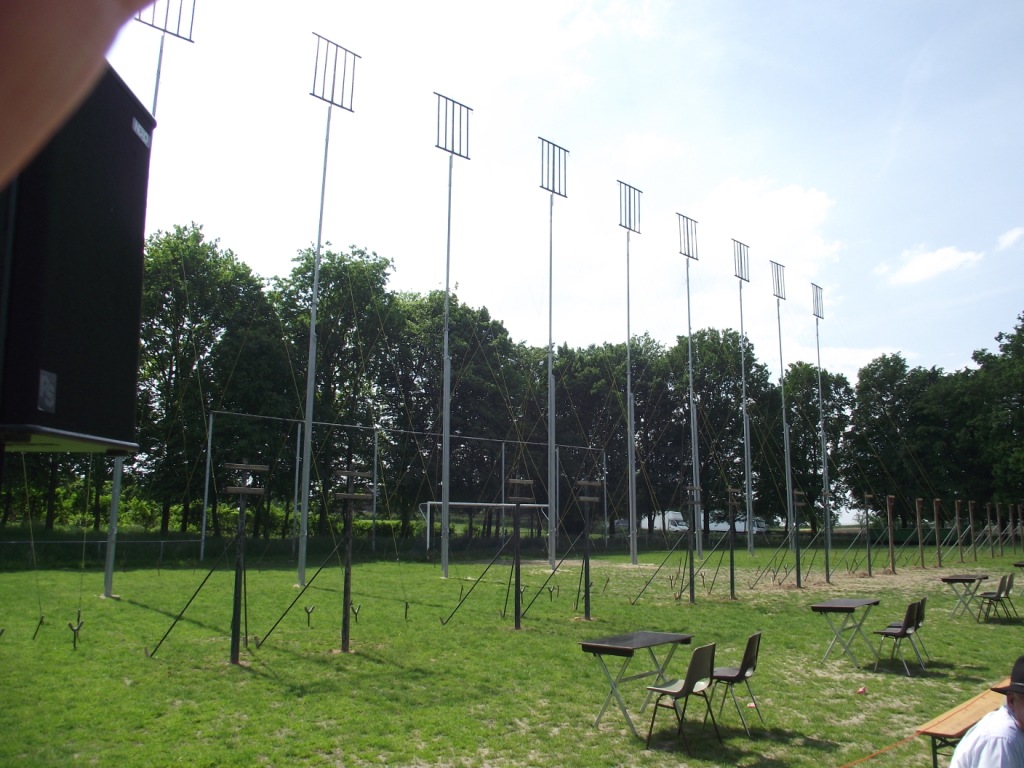
All the while the actual shooting competition was going on. The shooters take ten shots at elevated targets ("birds"), which are small (15mm) blocks held in a frame with ten targets to a column. These frames are 20 meters high.


The shooters use huge guns weighing 15 kilograms (36 lbs). The guns have open sites so there is no magnification of the tiny targets. They fire huge lead bullets, 12 or 16 mm in diameter (.47 or .63 caliber). Most shooters would take one or two shots and then rest while someone else held the weight of the weapon.

These are big and popular events in Limburg. If you like band music, marching, D&C (drill and ceremony), and a very unique shooting sport, this might be something you would be interested in. You can view the association's calendar at this LINK. Just click on the sub-menu "kalender" and look for a "Schuttersfeest" entry. The 75th anniversary of the Oud Limburgse Schuttersfederatie will take place on 23 September 2012 at Ellikom, Belgium. It looks to be about a thirty minute drive from Schinnen.

Tuesday, May 1, 2012

Price Comparing - Schinnen Commissary

I tend to be a thrifty person and I always look for the best deal. So I compare prices on everything I buy. The commissary has little control over their prices; they are set at the distribution level somewhere else. Some of the prices make no sense at all so you have to be careful.

One problem with trying to compare prices is that the commissary is not consistent. Some of their products are marked in $ per ounce and some are marked in $ per kilogram. I understand how that happens but it is just laziness on the part of the commissary not to convert everything to one standard. I am fairly sure that their computerized system can do this easier than I can do it in my head. Unless you have a calculator you cannot really compare prices to get the best deal.

The commissary also utilizes the same manipulations and tricks that commercial grocery stores use. That is they move items to the ends of the aisles and make it look like they are sale. Sometimes they are indeed on sale. A few weeks ago they had a few of their energy drinks on sale for a pretty good discounted price. But today when I was there I noticed they had boxes of energy drinks out on the end of an aisle that were actually 30 cents a can MORE expensive than the normal price. A box of ten cans was "On Sale" for $14.67 ($1.47 a can) but the per can price is normally $1.19. The Shopette was selling this same product at four cans for $2.00. 

Several times recently I have been charged more than the price listed on the item in the aisle. This has happened so often that I pay close attention when I am at the register. Luckily, the store policy is to go by the price on the shelf but you have to bring it to their attention.

I'm not knocking the commissary, the people there will do everything possible for you if you ask. But the misleading pricing makes it hard to stretch your shopping dollar. Also, be careful of the fake sales. They can cost you extra money. And always remember to check prices at the shopette and the PXtra as well. Lastly, don't forget that the commissary charges you a 5% tax so you have to add that to your pricing.

Are you aware that you can use coupons up to six months after they expire? (Only at Overseas Commissaries)

Saturday, March 24, 2012

Saving Money on Fuel (Gas and Diesel)

Have you filled your gas tank at Schinnen recently? We are approaching $5.00 a gallon gas and will certainly go over five dollars a gallon sometime soon.

                     Per Gallon          Per Liter          Change. (+/-)
Euro95          $4.928              $1.302             +0.095
Super Plus     $5.213              $1.377             +0.096
Diesel            $4.985              $1.317             +0.051

We are paying 92 cents a gallon more for gasoline than our colleagues that live and work in Germany do!  How can that be justified? But what can you do?

Here are some tips to help maximize your fuel dollars.

1. Sign up for and use the Aafes "Star Card" credit card. If you buy your fuel using your Star Card you will save five cents a gallon. Don't use the card for anything else and make sure you pay it off EVERY month so you are not paying interest charges. This method will also give you a very accurate record of your fuel use and costs.

2. Clean out your car. There's good reason to clean out the junk piled in the trunk. Every 100 pounds of added weight in a car reduces its fuel economy by about 2%. That is about 10 cents a gallon (9.96 cents at the current price). Hauling a cargo carrier, bikes, kayaks or other gear atop the car for a road trip is worse, decreasing fuel economy by 5% (24.9 cents a gallon).

3. Slow down. The U.S. Department of Energy estimates that for every 5 mph you drive over 60 mph you add $0.30 per gallon to the gas bill. Aggressive stops and starts waste another 33% at highway speeds and about 5% at slower, local speed limits.Take your time and slowly accelerate instead of stomping on the gas. My car, when it was brand new, was rated at 32 Miles per Gallon (MPG) on the highway; I generally get 36 MPG. I rarely go faster than 110 kph and I take a full kilometer to get up to speed when I enter the highway. I try to keep my engine RPMs under 2,000 as I accelerate. I also take my foot off the gas and start coasting about five hundred meters from the off ramp. If you stay in the right lane behind a large truck you gain at least 5-10 percent more efficiency by "drafting" in the already moving air behind the truck. These trucks are generally going between 90 and 100 kph.

4. Plan your Route. It's possible to cut down on mileage just by running a few errands on the same trip and choosing more efficient routes. You want to avoid traffic lights, stop signs, and stop and go traffic if at all possible. You can actually save gas by driving a little further if that route allows you to keep moving. Starting and stopping is why city mileage is so much lower than highway mileage. When you combine multiple errands into one drive you save fuel not just by driving a shorter overall distance but also because your car is more fuel efficient when it is warmed up to operating temperatures. So drive to your furthest location first if it makes sense to do so.

5. Car Pool. That is a Homer Simpson "Doh" statement to me. 99% of the military personnel here work at one of two places; USAG Schinnen or JFC Brunssum. Find somebody to share the ride and save a quick 50% on your fuel bill and general wear and tear on your car.

6. Check your Tire Pressure. Under- or over-inflated tires change the way the car handles, adding drag and speeding wear. That, in turn, reduces fuel efficiency by about 3%. Look to the driver's side door panel or owner's manual for information on proper inflation levels, Don't go by the figure stamped on the tire -- that's the maximum pressure the tire can handle. Tire pressure changes with temperature and over time so check your tire pressure at least every other time you fill your gas tank.

7. Turn off your Engine. Turn off your engine if you know you will be sitting still for 11 seconds or more. Eleven seconds seems to be the cut-off point. If you drive the same route to work and back every day then you know about how long a light is. One intersection in Beek that I go through every day is a complex intersection and the light is well over a minute long if it changes to red right when I get to it. I shut my car off and save a minute's worth of fuel. I do the same thing for railroad crossings. I go through three railroad crossings on my route to work and get stopped by a train at least once a week. That can be up to a three minute stop if a train goes by in each direction. Shutting off the engine saves a lot of fuel.

8. Bike once or twice a week. When I was stationed here twelve years ago a subordinate of mine and I rode our bikes to work two days a week. I lived in Neerbeek and he lived in Geleen; we worked in Brunssum. We met along the way. It was only a thirty minute bike ride (it also took thirty minutes to drive in a car) and was a nice addition to our fitness program. Riding a bike two days  a week saved me 40% on my driving costs.

9. Park your car and walk. When I go to Schinnen I park my car in whatever lot is closest to where I will have to carry the most items and then walk everywhere else. If I am picking up groceries, for example, I park in the commissary lot but then I walk to the PX, PX-tra, or bank from there.

10. Take public transportation. A single person going to Maastricht, Valkenberg, or Roermond, for example, can travel cheaper by train than by driving. In some cases a couple can also travel cheaper by train. But once you are talking about the whole family going somewhere it might be cheaper to drive. You need to do the math and figure out which is best for the circumstances.

Sunday, March 11, 2012

Recycling

Soapbox statement: I, personally, feel that everyone should recycle/reuse everything possible to cut down on waste and damage to the environment. When recycled materials are used in place of virgin materials during manufacturing, we avoid the environmental damage caused by mining for metals, drilling for petroleum, and harvesting trees. Producing recycled white paper creates 74% less air pollution and 35% less water pollution than producing paper from virgin fibers. Using recycled cans instead of extracting ore to make aluminum cans produces 95% less air pollution and 97% less water pollution. Recycling and re-manufacturing are 194 times more effective in reducing greenhouse gas emissions than land filling and virgin manufacturing.

Ok, that's my standpoint. BUT Recycling is imperative in The Netherlands to cut down on the trash you pay to have hauled away. In most towns, household trash is collected only once every other week and you are restricted to what you can fit in one trash bin. So out of necessity you must recycle.

What can you recycle? Most towns in The Netherlands pickup "Green Waste" (organic kitchen and yard waste) every other week (in between you garbage pickups). Most towns also pickup paper and cardboard once or twice a month and plastics once or twice a month. There will also be a glass recycle station in your town, possibly a clothes bin and maybe even a cooking oil receptacle. Lets look at things one at a time.

These are the rules for my gemeente (municipality) but they should be similar in your town.

Paper and cardboard (Oud papier en karton): Paper and cardboard needs to be clean and dry. Bundle the material but no heavier than 12 kilograms (a little over 28 pounds). I reuse paper grocery bags to hold my paper for recycle.Make sure that there is no plastic (tape, envelope windows, etc) mixed in and do not include waxed paper products such as milk cartons and juice containers.

Green Waste (GFT-aval): These bins are loaded by an "arm" from the truck so make sure there is 18 inches or so all around your container. Use the correct container, in my town they are green. You can include all organic kitchen and yard waste such as leaves, tree and bush trimmings, grass, weeds, etc. Do not include large bones or liquid fats and oils. Do not include cat litter. Do not pack the material in the bin, it has to be able to slide out when the truck turns it upside down. The lid must be closed completely. The bin cannot weigh more than 80 kilos (about 195 lbs)

Plastic (Plastic Heroes): You must use the special bags provided for plastic recycling. You can find a list of places to pick up these special bags at this LINK.What goes in the bag? Pretty much anything that is household plastic. What cannot go in the bag are: toys, plastic packaging with food or other product still in the container, plastic containers that held chemicals and solvents, expanded foam products such as fast food packaging, Styrofoam of any sort, plastic with aluminum foil or other non-plastic material attached.

The following items are things you will have to take somewhere. Most towns collect glass and cooking oil. Other stuff can be taken to the "Sort Center" at USAG Schinnen.

Glass: Glass is recycled as "White" (Witte Glas) glass, which is really clear glass, and "Colored" (Bunte Glas) glass. Porcelain, china, and terracotta is not glass. There is a glass bin a USAG Schinnen if you cannot find a recycle site near your house.

Metal: USAG Schinnen has containers for metal material. Do not throw appliances in these bins. Every time I dump my cans in the bin I see stuff that only a completely clueless or uncaring person would throw in the bin. This junk has to be pulled out by the Sort Center workers and that just isn't right. Microwave ovens must be taken to the sort center when the top is open so they can be handled by the workers there. The magnetron in the microwave is the problem. They take microwaves, they just have to handle them separately. 

Batteries: You can drop off used batteries (AA, AAA, C, D cells and the square 9-volts batteries) at the commissary and the Sort Center. Do not throw your batteries in the general trash. Batteries contain many toxic materials that severely pollute the environment. These materials can and should be extracted from the batteries and reused.You drop off car batteries at the Sort Center but be advised that you get money back at the Car Care Center if you trade in an old car battery when you buy a new one.

Hazardous Waste: You can drop off very small amounts of hazardous waste in the Red receptacle at the Sort Center lower area or wait until the top section is open to drop it off there.

Motor Oil: If you change your own oil (from your car) you can drop off the used motor oil at the Sort Center when the top part is open. Make sure the oil is in a sturdy container. I reuse the large plastic containers that I buy cat litter in for this purpose.

Wood: If you have large wooden items to dispose of they can take those at the Sort center. Remove all non-wood material (nails, nuts&bolts, screws, hinges, etc.) and recycle those as metal waste.

USAG Sort Center:

These are some of the bins located on the bottom part of the sort center. They are available 24 hours a day but they take them up to the top area when that is open to empty and clean them.


This is the top portion of the sort center. If you have any questions ask the man in the booth to the left. He does not speak much English, which seems pretty stupid to me to hire a guy that speaks limited English to be a customer service person. But he'll figure out what you need. He is responsible for this site and will keep an eye on you so do not try to cheat and dump stuff you shouldn't.


 These are the hours for the top portion of the Sort Center.


I recycle everything I can. As a result, I only have to put my trash bin out for collection once every other month. That saves the US Army money, they get charged every time your bin is collected, and saves the environment.

Sunday, March 4, 2012

Small Town Touring - Meerssen

Meerssen is easy to get to from anywhere in the Schinnen/Brunssum area since it sits near the junction of A2 and A79. Meerssen was also near the junction of two ancient Roman roads, which is why the town dates back to those days and beyond. One of these roads, the "Via Belgica", started on the French coast, crossed the Maas river at Maastricht, and ran past Meerssen and Heerlen then into Germany.

The first major event to occur in this small town was The Treaty of Meerssen or Mersen, which was a partition treaty of the Carolingian Empire concluded on 8 August 870 by the two surviving sons of Emperor Louis the Pious, King Charles the Bald of West Francia and Louis the German of East Francia.

Around the middle of the 10th century Meerssen was the personal property of queen Gerberga, the daughter of King Henry I. She was the spouse of Louis IV of France. In 968 she donated all her property to the abbey of Saint Remigius in Reims, France. The Basilica in Meerssen started out as a Monastery Church affiliated with the abbey in Reims and it replaced the royal family chapel that was in Meersseen for over 100 years.

The Basilica is probably the most notable feature of the town today due to its age and style. There is an excellent description of the Basilica at this LINK.

The Basilica is open most days until 1700 hrs (5:00 PM) but it is an active church so make sure a service is not being conducted before you walk in.

To the right of the church, if you were looking at it as in the picture above, there is a small strolling park that is very nice. There is a swan pond and a pathway with plenty of benches to sit and relax, enjoy the view, and perhaps have a snack or drink. Be careful if you walk in the grass, the ducks, geese, and swans have been there and there are lots of their droppings.

Across the pond is an ornate and pretty gazebo. It was completely renovated about two years ago and now would be a perfect spot for photographs of your family.


During the history of The Netherlands many outside forces, Spain, Austria, France, and various noble families and even the Catholic Church officials, bought, sold, and traded parts of what is now The Netherlands. Each time this was done, the religious denomination prevalent in the affected areas changed. Churches would change from Catholic to Protestant and back again. Since many small towns and villages only had the means to support one church building, the Protestants and Catholics often had to share buildings. Most of the time this worked out fine but sometimes it was an issue. 

In 1836, Belgian King Leopold I donated money to build four Protestant churches; one each in Beek, Meerssen, Gulpen, and Heerlen. It was not completely altruistic, he was possibly trying to further divide the Catholic and Protestant people. Leopold himself was Protestant. All of these churches are called, "Leopoldskerk", or Leopold's Church. The one in Meerssen is across the street from the back side of the Basilica. I was fortunate enough to see a woman working on the church's grounds and asked her if I could go inside and look around. She said, "sure, but there is not much to see." She was right about that. The church has been deconsecrated and largely striped. Only the organ pipes and lectern remain. The building is being renovated to be a sort of civic hall for ceremonies and meetings.

Also in Meerssen is a former Jewish Synagogue.

Jewish cemetery on Tussen de Bruggen
References to Jews living in Meerssen survive from the late seventeenth century. In 1715, a Jewish cemetery was established at Geulbrugge on the road from Meerssen to Rothem (now called, "Tussen de Bruggen". Another old Jewish cemetery still stands in the former hamlet of Haasdal now part of the village of Schimmert. (I've been to this one too but it is very hard to find.) A sizeable Jewish community did not come into being at Meerssen until the 1770's. At that time, religious services were held in a private home on the corner of the Kerkstraat and the Beekstraat. By 1796, the community utilized a hall in the Steegstraat as its synagogue. During the late eighteenth century the surrounding of Meerssen was plagued by roving gangs of bandits, mostly comprised of Jews.

With the reorganization of Dutch Jewry during the 1820's the Jewish community at Meerssen was declared a regional community (Ringsynagoge) under the aegis of the Jewish community at Maastricht. The Jewish population of Meerssen remained relatively constant throughout the nineteenth century; thereafter, its numbers fell due to the general trend of migration to the more prosperous west of the Netherlands. A new synagogue, located on the Kuileneindestraat, was consecrated in 1853. Official and voluntary organizations at Meerssen included the community directorate and a women's society. The community also provided Jewish education for its children.

By the eve of the Second World War, the Jewish community at Meerssen had become so small that it effectively had ceased to function. Under the wartime German occupation of the Netherlands, almost all the remaining Jews of Meerssen were deported and murdered; only a few managed to escape death in hiding. The synagogue came through the war undamaged despite the theft of part of its contents. The Jewish community at Meerssen was officially dissolved in 1947 and administratively merged into the Jewish community at Maastricht. The synagogue was sold in 1946. What was left of its interior was removed and reinstalled in the synagogue at Maastricht. The former synagogue at Meerssen was heavily damaged by fire in 1977. Later, it was restored by the Kring van Vrienden van de Synagoge Meerssen (The Association of Friends of the Meerssen Synagogue). The former synagogue has served as a social and cultural center since 1989. A Torah scroll originally from Meerssen and later in the possession of the Jewish Historical Museum Amsterdam was returned to the former synagogue in 1996. The Jewish cemetery at Meerssen was declared a national monument and later restored. It is currently maintained by the local authorities.

Meerssen has a small but surprisingly busy shopping district. It is not especially pedestrian friendly since the roads are not closed off but the sidewalks are wide and the speed limit is only 30kph. There are a few brand name stores, grocery stores, cafe`s, and pubs in the town. The stores go beyond the obvious area of the downtown district. It wouldn't be a shopping destination for me but if you visit the town you can definitely get something to eat or drink while there.

There are many interesting buildings spread out through the town but none that are exceptionally old (by local standards). These are typical "Maasland" style buildings from the early to mid-1800's.


If you walk or drive south out of Meerssen, past the train station, across the train tracks, toward Rothem and ultimately Maastricht, you will see the Jewish cemetery on your right.  If you continue straight ahead you will come to a traffic circle. Go straight through and under highway A2 and head towards Maastricht. You will pass a Gatehouse for an estate, seen here.  Just a little further on there will be a road to your right that passes by the estate. This road is called Weert Straat. 

Follow that over the railroad tracks and you will come to Kasteel Vaeshartelt. Follow signs to Parking (left of the main building seen here). This former home of King William is now a hotel and conference center. On the grounds is a small restaurant and what they are calling an English Garden. The garden area is open and free to the public during daylight hours.

The information sign says the strolling route would take about an hour of leisurely walking and there are explanatory signs along the way (only in Dutch I am sorry to say). But the signs have old pictures or drawings so you can at least see what the place looked like in its hay day. I walked around a little bit but I was walking to Maastricht so I didn't spend too much time here.

If you walk from Meerssen, it is a pleasant 30 minute walk at the most and it will allow you to stop and see the cemetery and the estate I mentioned above. You might walk up an appetite and then enjoy your own snack while sitting in the garden or buy something at the cafe` on the grounds.


I walked in to Maastricht and that portion of the trip is unrelated to Meerssen. Actually so is Kasteel Vaeshartelt but it is well worth the small side trip for you.

I hope you have a chance to get out and enjoy the small towns in our area.