Sunday, March 11, 2012

Recycling

Soapbox statement: I, personally, feel that everyone should recycle/reuse everything possible to cut down on waste and damage to the environment. When recycled materials are used in place of virgin materials during manufacturing, we avoid the environmental damage caused by mining for metals, drilling for petroleum, and harvesting trees. Producing recycled white paper creates 74% less air pollution and 35% less water pollution than producing paper from virgin fibers. Using recycled cans instead of extracting ore to make aluminum cans produces 95% less air pollution and 97% less water pollution. Recycling and re-manufacturing are 194 times more effective in reducing greenhouse gas emissions than land filling and virgin manufacturing.

Ok, that's my standpoint. BUT Recycling is imperative in The Netherlands to cut down on the trash you pay to have hauled away. In most towns, household trash is collected only once every other week and you are restricted to what you can fit in one trash bin. So out of necessity you must recycle.

What can you recycle? Most towns in The Netherlands pickup "Green Waste" (organic kitchen and yard waste) every other week (in between you garbage pickups). Most towns also pickup paper and cardboard once or twice a month and plastics once or twice a month. There will also be a glass recycle station in your town, possibly a clothes bin and maybe even a cooking oil receptacle. Lets look at things one at a time.

These are the rules for my gemeente (municipality) but they should be similar in your town.

Paper and cardboard (Oud papier en karton): Paper and cardboard needs to be clean and dry. Bundle the material but no heavier than 12 kilograms (a little over 28 pounds). I reuse paper grocery bags to hold my paper for recycle.Make sure that there is no plastic (tape, envelope windows, etc) mixed in and do not include waxed paper products such as milk cartons and juice containers.

Green Waste (GFT-aval): These bins are loaded by an "arm" from the truck so make sure there is 18 inches or so all around your container. Use the correct container, in my town they are green. You can include all organic kitchen and yard waste such as leaves, tree and bush trimmings, grass, weeds, etc. Do not include large bones or liquid fats and oils. Do not include cat litter. Do not pack the material in the bin, it has to be able to slide out when the truck turns it upside down. The lid must be closed completely. The bin cannot weigh more than 80 kilos (about 195 lbs)

Plastic (Plastic Heroes): You must use the special bags provided for plastic recycling. You can find a list of places to pick up these special bags at this LINK.What goes in the bag? Pretty much anything that is household plastic. What cannot go in the bag are: toys, plastic packaging with food or other product still in the container, plastic containers that held chemicals and solvents, expanded foam products such as fast food packaging, Styrofoam of any sort, plastic with aluminum foil or other non-plastic material attached.

The following items are things you will have to take somewhere. Most towns collect glass and cooking oil. Other stuff can be taken to the "Sort Center" at USAG Schinnen.

Glass: Glass is recycled as "White" (Witte Glas) glass, which is really clear glass, and "Colored" (Bunte Glas) glass. Porcelain, china, and terracotta is not glass. There is a glass bin a USAG Schinnen if you cannot find a recycle site near your house.

Metal: USAG Schinnen has containers for metal material. Do not throw appliances in these bins. Every time I dump my cans in the bin I see stuff that only a completely clueless or uncaring person would throw in the bin. This junk has to be pulled out by the Sort Center workers and that just isn't right. Microwave ovens must be taken to the sort center when the top is open so they can be handled by the workers there. The magnetron in the microwave is the problem. They take microwaves, they just have to handle them separately. 

Batteries: You can drop off used batteries (AA, AAA, C, D cells and the square 9-volts batteries) at the commissary and the Sort Center. Do not throw your batteries in the general trash. Batteries contain many toxic materials that severely pollute the environment. These materials can and should be extracted from the batteries and reused.You drop off car batteries at the Sort Center but be advised that you get money back at the Car Care Center if you trade in an old car battery when you buy a new one.

Hazardous Waste: You can drop off very small amounts of hazardous waste in the Red receptacle at the Sort Center lower area or wait until the top section is open to drop it off there.

Motor Oil: If you change your own oil (from your car) you can drop off the used motor oil at the Sort Center when the top part is open. Make sure the oil is in a sturdy container. I reuse the large plastic containers that I buy cat litter in for this purpose.

Wood: If you have large wooden items to dispose of they can take those at the Sort center. Remove all non-wood material (nails, nuts&bolts, screws, hinges, etc.) and recycle those as metal waste.

USAG Sort Center:

These are some of the bins located on the bottom part of the sort center. They are available 24 hours a day but they take them up to the top area when that is open to empty and clean them.


This is the top portion of the sort center. If you have any questions ask the man in the booth to the left. He does not speak much English, which seems pretty stupid to me to hire a guy that speaks limited English to be a customer service person. But he'll figure out what you need. He is responsible for this site and will keep an eye on you so do not try to cheat and dump stuff you shouldn't.


 These are the hours for the top portion of the Sort Center.


I recycle everything I can. As a result, I only have to put my trash bin out for collection once every other month. That saves the US Army money, they get charged every time your bin is collected, and saves the environment.

Sunday, March 4, 2012

Small Town Touring - Meerssen

Meerssen is easy to get to from anywhere in the Schinnen/Brunssum area since it sits near the junction of A2 and A79. Meerssen was also near the junction of two ancient Roman roads, which is why the town dates back to those days and beyond. One of these roads, the "Via Belgica", started on the French coast, crossed the Maas river at Maastricht, and ran past Meerssen and Heerlen then into Germany.

The first major event to occur in this small town was The Treaty of Meerssen or Mersen, which was a partition treaty of the Carolingian Empire concluded on 8 August 870 by the two surviving sons of Emperor Louis the Pious, King Charles the Bald of West Francia and Louis the German of East Francia.

Around the middle of the 10th century Meerssen was the personal property of queen Gerberga, the daughter of King Henry I. She was the spouse of Louis IV of France. In 968 she donated all her property to the abbey of Saint Remigius in Reims, France. The Basilica in Meerssen started out as a Monastery Church affiliated with the abbey in Reims and it replaced the royal family chapel that was in Meersseen for over 100 years.

The Basilica is probably the most notable feature of the town today due to its age and style. There is an excellent description of the Basilica at this LINK.

The Basilica is open most days until 1700 hrs (5:00 PM) but it is an active church so make sure a service is not being conducted before you walk in.

To the right of the church, if you were looking at it as in the picture above, there is a small strolling park that is very nice. There is a swan pond and a pathway with plenty of benches to sit and relax, enjoy the view, and perhaps have a snack or drink. Be careful if you walk in the grass, the ducks, geese, and swans have been there and there are lots of their droppings.

Across the pond is an ornate and pretty gazebo. It was completely renovated about two years ago and now would be a perfect spot for photographs of your family.


During the history of The Netherlands many outside forces, Spain, Austria, France, and various noble families and even the Catholic Church officials, bought, sold, and traded parts of what is now The Netherlands. Each time this was done, the religious denomination prevalent in the affected areas changed. Churches would change from Catholic to Protestant and back again. Since many small towns and villages only had the means to support one church building, the Protestants and Catholics often had to share buildings. Most of the time this worked out fine but sometimes it was an issue. 

In 1836, Belgian King Leopold I donated money to build four Protestant churches; one each in Beek, Meerssen, Gulpen, and Heerlen. It was not completely altruistic, he was possibly trying to further divide the Catholic and Protestant people. Leopold himself was Protestant. All of these churches are called, "Leopoldskerk", or Leopold's Church. The one in Meerssen is across the street from the back side of the Basilica. I was fortunate enough to see a woman working on the church's grounds and asked her if I could go inside and look around. She said, "sure, but there is not much to see." She was right about that. The church has been deconsecrated and largely striped. Only the organ pipes and lectern remain. The building is being renovated to be a sort of civic hall for ceremonies and meetings.

Also in Meerssen is a former Jewish Synagogue.

Jewish cemetery on Tussen de Bruggen
References to Jews living in Meerssen survive from the late seventeenth century. In 1715, a Jewish cemetery was established at Geulbrugge on the road from Meerssen to Rothem (now called, "Tussen de Bruggen". Another old Jewish cemetery still stands in the former hamlet of Haasdal now part of the village of Schimmert. (I've been to this one too but it is very hard to find.) A sizeable Jewish community did not come into being at Meerssen until the 1770's. At that time, religious services were held in a private home on the corner of the Kerkstraat and the Beekstraat. By 1796, the community utilized a hall in the Steegstraat as its synagogue. During the late eighteenth century the surrounding of Meerssen was plagued by roving gangs of bandits, mostly comprised of Jews.

With the reorganization of Dutch Jewry during the 1820's the Jewish community at Meerssen was declared a regional community (Ringsynagoge) under the aegis of the Jewish community at Maastricht. The Jewish population of Meerssen remained relatively constant throughout the nineteenth century; thereafter, its numbers fell due to the general trend of migration to the more prosperous west of the Netherlands. A new synagogue, located on the Kuileneindestraat, was consecrated in 1853. Official and voluntary organizations at Meerssen included the community directorate and a women's society. The community also provided Jewish education for its children.

By the eve of the Second World War, the Jewish community at Meerssen had become so small that it effectively had ceased to function. Under the wartime German occupation of the Netherlands, almost all the remaining Jews of Meerssen were deported and murdered; only a few managed to escape death in hiding. The synagogue came through the war undamaged despite the theft of part of its contents. The Jewish community at Meerssen was officially dissolved in 1947 and administratively merged into the Jewish community at Maastricht. The synagogue was sold in 1946. What was left of its interior was removed and reinstalled in the synagogue at Maastricht. The former synagogue at Meerssen was heavily damaged by fire in 1977. Later, it was restored by the Kring van Vrienden van de Synagoge Meerssen (The Association of Friends of the Meerssen Synagogue). The former synagogue has served as a social and cultural center since 1989. A Torah scroll originally from Meerssen and later in the possession of the Jewish Historical Museum Amsterdam was returned to the former synagogue in 1996. The Jewish cemetery at Meerssen was declared a national monument and later restored. It is currently maintained by the local authorities.

Meerssen has a small but surprisingly busy shopping district. It is not especially pedestrian friendly since the roads are not closed off but the sidewalks are wide and the speed limit is only 30kph. There are a few brand name stores, grocery stores, cafe`s, and pubs in the town. The stores go beyond the obvious area of the downtown district. It wouldn't be a shopping destination for me but if you visit the town you can definitely get something to eat or drink while there.

There are many interesting buildings spread out through the town but none that are exceptionally old (by local standards). These are typical "Maasland" style buildings from the early to mid-1800's.


If you walk or drive south out of Meerssen, past the train station, across the train tracks, toward Rothem and ultimately Maastricht, you will see the Jewish cemetery on your right.  If you continue straight ahead you will come to a traffic circle. Go straight through and under highway A2 and head towards Maastricht. You will pass a Gatehouse for an estate, seen here.  Just a little further on there will be a road to your right that passes by the estate. This road is called Weert Straat. 

Follow that over the railroad tracks and you will come to Kasteel Vaeshartelt. Follow signs to Parking (left of the main building seen here). This former home of King William is now a hotel and conference center. On the grounds is a small restaurant and what they are calling an English Garden. The garden area is open and free to the public during daylight hours.

The information sign says the strolling route would take about an hour of leisurely walking and there are explanatory signs along the way (only in Dutch I am sorry to say). But the signs have old pictures or drawings so you can at least see what the place looked like in its hay day. I walked around a little bit but I was walking to Maastricht so I didn't spend too much time here.

If you walk from Meerssen, it is a pleasant 30 minute walk at the most and it will allow you to stop and see the cemetery and the estate I mentioned above. You might walk up an appetite and then enjoy your own snack while sitting in the garden or buy something at the cafe` on the grounds.


I walked in to Maastricht and that portion of the trip is unrelated to Meerssen. Actually so is Kasteel Vaeshartelt but it is well worth the small side trip for you.

I hope you have a chance to get out and enjoy the small towns in our area.

Sunday, February 26, 2012

Day Trips - Roermond

I took a day trip to Roermond on Saturday mainly to see what I thought was a full-scale museum called the "Historiehuis". I saw some pictures of it online and thought it would be interesting. The Historiehuis turned out to be a large room inside the city's library at Neerstraat 11. It was a very well done exhibit but I saw everything in about twenty minutes. But luckily, Neerstraat 11 is inside the City Centrum of Roermond and so I toured the rest of the historical "Old Town", as Americans would call it.

Roermond is easy to get to by car or train. By car, head north on highway A2 and then take A73 directly to Roermond. Go to this website to find public parking and addresses to plug into your GPS. You could take a train from Beek, Spaubeek, Schinnen, or Sittard but that will cost you €11.00 - 13.00. If you are going by yourself and you intend to spend the day, the train is the best way to go. Between gas and parking costs driving by yourself would be more expensive.

You can start reading about what there is to see and do in Roermond at the Dutch Tourist bureau VVV site. Go to this LINK


The Centrum, or old city center, is quite large and very pedestrian friendly. It is a typical old city layout though (lots of curved streets) and so you can't really go up and down each street like you can with a modern grid layout. It is nice for wandering but you'll probably end up passing by the same place more than once. The main attractions are posted on sign posts, with direction but not distance, at most of the main street corners. There is also a VVV Tourist Office located at Markt 17, 6041 EL Roermond. This is on the main market square near the old Gemeente Huis (City Hall). I didn't go in but most VVV offices have good tourist guides, maps, and books concerning the local area. You can also ask the workers questions on what to see.

I used Dutch the whole day so I don't know how well they do with English here. This was one of the few places where the people I talked to did not switch over to English after talking to them in my limited Dutch. I found everyone to friendly and polite though.

I recommend you visit both the churches in the Centrum; Saint Christopher's Church and Munsterkerk. Munsterkerk was built in the early 1200's and is a good example of a medieval church inside. The interior is beautiful. Both churches have English language pamphlets available that explain the major features of the church.


There is food of every kind and price range available here. I bought fresh squeezed orange juice and fried fish at the market and a small apple pie for dessert at a bakery later. prices were reasonable but I always carry drinks with me since they usually cost too much. There are few public bathrooms so use them when you come across them.

 The architecture of the buildings is fantastic and if you like that sort of thing you can see buildings from the 1200s up to modern times and everything in between. Many of the older buildings have markers that explain when it was built, for whom, and what the building was used for (all in Dutch though). 

All the major store chains are represented as well as lots of mom & pop specialty stores. Roermond also has a Designer Outlet center near the Centrum (Stadsweide 2, 6041 TD Roermond) but I wasn't interested in seeing that. The outlet centers tend to be high end clothing stores and that's not my thing.


There was a small Jewish population in the city off and on over the centuries and I saw their former school and synagogue on Hamstraat down near the train station. You can read about the Roermond Jewish community at this LINK. According to the website there is a small museum in the former synagogue. I didn't know that when I was there but I'll check it out next time I visit Roermond.


All in all I had a good time and ate some good food. There is plenty more for me to see and I look forward to visiting again when the weather is warmer. Roermond is not exactly high on the typical tourist's list of places to see but maybe it should be.

Saturday, February 18, 2012

Carnaval (or Carnival)

What is Carnaval or Mardi Gras?
 
Carnaval  (Mardi Gras in the US) is a festive season typically involving a public celebration or parade combining some elements of a circus, mask and public street party. People often dress up or masquerade during the celebrations, which mark an overturning of daily life. The festival culminates on Shrove Tuesday or Fat Tuesday, which is the day before Ash Wednesday. The date is dependent on that of Easter, and thus can vary from as early as 3 February to as late as 9 March. While in recent years Carnaval has grown in popularity as a raucous, hedonistic event, its roots lie in the Christian calendar, as the “last hurray” before Lent begins on Ash Wednesday. 

Origins of The Name
 
The origin of the word Carnaval or Carnival is disputed, but many believes it comes from the Italian words “carne levare”, which literally means “to remove meat”, since meat is prohibited during Lent.

Dutch Carnival Traditions

Carnival is mainly celebrated in the south of The Netherlands. The provinces Limburg and Noord-Brabant are the predominantly Catholic provinces of the Netherlands, where most inhabitants celebrate Carnival. Though some people take the Carnival traditions very seriously, most people keep it simple and just drink, sing and dance wearing a colorful outfit. (I had discussions with Dutch soldiers from outside of Provincie Limburg and they find the festivities somewhat frivolous and silly. The farther north you go in The Netherlands to more "serious" the people seem to be.)

The Carnival celebrations in Maastricht start after the mayor symbolically hands over the key to the city to Prince Carnival. For three days, the Carnival Prince has control of the city and, together with his subjects, celebrates the temporary establishment of their Kingdom of Fools. Merrymakers make their way from pub to pub and greet Prince Carnival with three cheers of “Alaaf”. It seems like each little town and village elects their own Carnaval Prince. The process begins in mid-November and you might have seen signs around your town for the men trying to get "elected" Prince.


Carnival Celebrations

From the 19th of February until the 21st of February 2012 Carnival in Maastricht will be celebrated, also known as “Vasteloavend in Mestreech”. During this three day festival all people forget their boundaries and the city center of Maastricht is filled with thousands costumed people.

On Saturday the 18th of February Carnival will be opened with performances of several Limburg artists. This is also called the “Vastelaoftrap”. The entrepreneurs from the Vrijthof, a famous and large square in the city center of Maastricht, organize this parade of artists to get in the mood for the three craziest days of the year.
Sunday the 19th of February is the first official day of Carnival. On this day the annual parade takes place through the city center of Maastricht. With dazzling decorated vehicles, costumes and music the Carnival celebrating people of Maastricht will go through the city.

The festival will take place on the streets and in the many cafés, although the authentic people of Maastricht only celebrate on the streets. Everywhere you go you see costumed people who enjoy the cosiness, music and of course a drink. People celebrate from early in the morning until late in the evening to fully enjoy these three careless days. Carnival takes place in the city center of Maastricht, but also in the local neighborhoods people celebrate in local community houses and cafés.

Are you in the mood to get crazy? Come and celebrate Carnival in Maastricht and don’t forget your costume and a good mood!

If you are visiting Maastricht during these three days of Carnival, please keep in mind that many shops are closed. 

The Maastricht Tourist bureau published this flyer on the celebrations in the city. 

Friday, February 10, 2012

Index to Non-Tourist Subjects

I've been posting since May 2011 and it is probably getting difficult to find specific subjects of interest so I'm posting an index of sorts. This index will be for the non-tourist subjects I have covered. Just click on a link below and you'll go straight to that posting. Do you have any suggestions for additional Subjects? Please send me a comment.

If you enjoy this Blog, please tell your family and friends about it.


1. Bringing your Automobile to The Netherlands

2. Electric


3. Electric Stuff, continued

4. Drinking Water

5. Banking in The Netherlands

6. Movie Theaters

7. Medical and Dental Care

8. Gasoline and Esso Cards

9. Schinnen Care Care Garage

10. Car Inspections (Netherlands)

11. Dutch Weather

12. US Radio Reception

13. German Winter Tire Regulations

14. Shopping on Schinnen

15. Winter Driving

16. Aafes Gas Prices (Belgium, Germany, Netherlands)

17. Dutch Road Hazards

Saturday, February 4, 2012

Small Town Touring - Elsloo

Most people that come to The Netherlands visit the big tourist attractions; Amsterdam, Delft, Kinderdijk, Keukenhof, Maastricht, Valkenburg, etc. And those are all nice places to see. But if you only go to the tourist areas you will never get a good feel for the real Netherlands, The Netherlands off the beaten path. I have been to the big attractions, several times in many cases, and enjoyed them every time. But I also like to get off the main roads and find little towns and villages and see what they have to offer. So I'm going to start highlighting some of the out-of-the-way places I have visited.

The first place I'll highlight is the little town of Elsloo. There is evidence of habitation going back 7,000 years. Digs in the area have found stone age tools and pottery. Evidence of Roman settlements have also been found. This is not surprising, man has always lived along rivers and waterways. The other attraction was the fine, fertile loam soil. It is very easy to work and the early settlers to this area followed the loam soil deposits and established farming communities on it.

Elsloo is easy to get to by heading toward the train station in Beek and then going straight past it to the next round about. Take the second exit and you are in the newer part of Elsloo. Just plug this address into your GPS and it will take you to Kasteelelsloo and you can park there for free. Maasberg 1, 6181 GV, Elsloo, Nederland. 

The old, original part of the town is in the area of the kasteel, which is now a hotel and convention center. More than half of the town was destroyed when the Julianakanaal was built in the early 1930's. The buildings that remain were mostly built in the early to mid 1600's.

Kasteel Elsloo, where you will park, was built on the site of a former brewery. 

There had earlier been a fortress castle in this area, to the west, but between several wars and constant flooding of the River Maas, it was finally destroyed completely. This castle had been plundered by Viking raidiers traveling on the Maas and they set up an encampment where the village stands today. The Maas has changed its route many times and the former castle is now under the Maas. When water levels are extremely low you can see parts of the foundation in the river. 


The current Kasteel was built as a residence. The first Lord of Elsloo was Arnulf or Arnoldus van Elsloo and there were many intermarriages between minor nobility and aristocrats and the kasteel passed down through these various families. One of the last noble women to own the residence later married Charles de Grimaldi, the Prince of Monaco. In 1887 the kasteel was bought by Hendrikus Leonardus Jurgens, the oleo margarine magnate. He used the residence as a summer retreat. Lastly it was purchased by the town of Elsloo.

Behind the kasteel is a large botanical garden. I never seem to be there when it is open so I can't really say much about it except when I read customer comments from the hotel, they mostly said how nice the garden and strolling park were. The garden is supposed to be open on Sundays between 1 April and 1 October but only from 1400 - 1700 hrs. The strolling park is free and open to the public. I have walked in the park many times and there is a network (a maze really) of marked trails that you can walk. It is mostly on a hillside so be prepared for that. Also at the kasteel is an old water mill. I have tried many times to see that as well but always seem to miss the open times. The kasteel lies right beside the Juliana Canal and that is also a pleasant walk or a nice place to just sit and watch the birds and barges. I have eaten lunch beside the canal a couple times and it's always nice.


The Maas was a very important waterway used for transporting supplies and trade goods. The Maas flows from France to the North Sea. It is 575 miles long and drops in elevation from 1,342 feet in France to sea level. In Elsloo there was a Shipper's Exchange (Schippersbeurs) where fees and schedules were negotiated and paid. Shippers used the "Beurs" to arrange their shipping contracts. This building has very thick stone walls, heavy wood doors, and in the back of the building (now a residence) you can still see the iron bars used to protect the windows. I imagine quite a bit of money was stored here for business transactions. The yellow building in this photo is the current Schippersbeurs Musea. It is only open for limited hours but it is an interesting if small museum. You can see everything in a bit less than two hours. The museum is open:

Dinsdag (Tue)      : 13.00 - 16.00 uur  | Donderdag (Thu): 13.00 - 16.00 uur
Woensdag (Wed) : 13.00 - 16.00 uur  |  Zondag (Sun)     : 14.00 - 17.00 uur

 There are many interesting buildings in the old part of the town if you like that sort of thing (I do). The church there is also quite nice. Between strolling through the town, walking in the park, seeing the kasteel's garden and mill (if you are lucky), and maybe visiting the museum, I think you could spend a whole day here. Luckily I live 12 minutes away so I can come and go to see things.

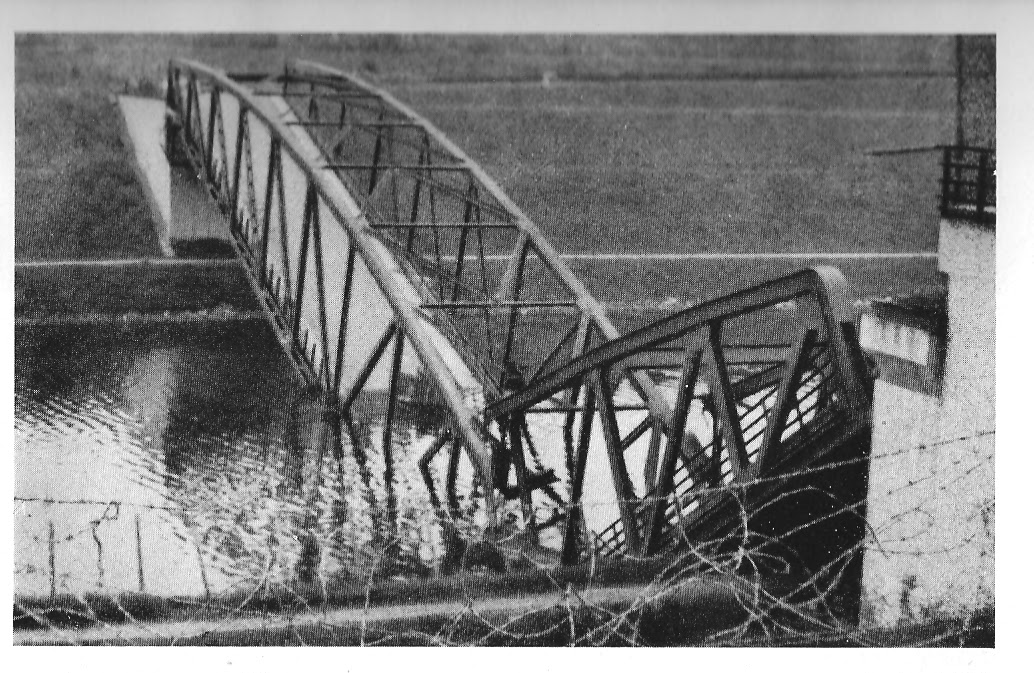
On 10 May, 1940, the Germans attacked The Netherlands with no warning. Their main goal was France but unfortunately The Netherlands was in the way. The Netherlands capitulated after four days of hard fighting. One of the places the Germans went through on their way to France was Elsloo. The Dutch army blew up the bridge crossing the Juliana Canal to attempt to slow down the German attack on their close ally, Belgium. 

But this was only a temporary setback for the German war machine. They quickly built a pontoon bridge to span the canal and then the River Maas. The Netherlands endured almost five years of German occupation and then the fighting as the American's and their allies came through this area pushing the Germans out of The Netherlands and eventually back to Berlin.


Tuesday, January 24, 2012

Dutch Road Obstacles

The Dutch do some odd things, from my point of view, and one of the strangest is to purposely install road obstacles. Their idea is that by making the roads more difficult to drive on and more dangerous, that people will slow down and the roads will be safer. That is a very illogical train of thought if you ask me.

In the United States, we generally try to make our roads as efficient and safe as possible. Our goal is to move the most number of cars from point A to point B as possible while still maintaining a margin of safety. In parts of Europe, to include The Netherlands, it seems they do everything they can to impede the smooth flow of traffic. 

In The Netherlands you can park almost anywhere on the street and I have come around blind corners or bends in the road only to find a car, truck, or combi van parked in my driving lane. A quick swerve to avoid a collision and I continue on my way. This by itself is so unsafe it is hard to believe it is allowed.

Many roads, when you are off the highways, are too narrow for two vehicles to pass at normal driving speeds. One of the vehicles must slow down and pull to to far edge of the road to allow the other vehicle to pass. In my area of south Limburg, there are many roads that I drive on every week where two cars cannot pass each other at all unless one goes off the edge of the road. Last summer one of these heavily used roads was closed for several weeks for construction and I figured they were finally going to widen it to two full lanes. Wishful thinking. All they did was resurface the narrow road as it was and now it is even harder to pull off and then back onto the road because it is now 3-4 inches higher than the shoulder.

But the most unbelievable safety hazards are the ones the Dutch intentionally place on the road. On the five mile drive from my house to USAG Schinnen, for example, I must navigate around no less than twelve obstacles blocking or restricting traffic flow. Below are some examples.

One of the first things you have to learn is who has the priority to go through one of these traffic restrictions. You'll learn this when you study for your Driver's License.  In this case the oncoming traffic, shown by the black arrow, has priority. The reddish lane is a Bike Lane. You are not allowed to block the bike lane. If you come to this obstacle at the same time as an oncoming vehicle, you must stop and let them pass. And this makes the road safer how?

In this example there is no priority sign so you have to either be bold and just take the priority or stop and let the oncoming car go through. As you can see the bike lane also disappears so now bikes are also trying to get through the obstacle and they will generally stop for no one. At night this is a difficult road hazard to see until you are right on it. All it has to mark it is a small strip of shiny metal on the short pole.

In some places the Dutch weren't satisfied with only one hazard, they installed two or three. At this obstacle you have a post and curb stones in the middle of you lane and then what looks like a way to go around to the right. But that is also blocked by two dark grey posts (difficult to see at night) and a parked car in what looks like part of the road but is not. I had to stop so the car with priority could come through.

Dremples, we call them speed bumps and the British call them "Lazy Policemen". You will find these going into and out of every village. In most cases they are not too bad but I have come across several in the area that I have to creep over so I don't bottom out my car. After this Dremple you see two "Fake" bike lanes. They are fake because while they are marked they are not protected lanes like the reddish colored ones are.

Some Dremples are integrated into other traffic hazards. This one going into my village is especially hazardous because of an adjoining road that comes into the main road just ahead of this. I have sat here burning gas for over a minute or two as cars came out of the village. This one, at least, is well marked because of several accidents in the past.


Split Dremples rock your boat. I hate these. Only one side of your car goes over the bump and so even at a very slow speed it rocks you back and forth. This is where my groceries usually get scattered in the trunk of my car and I have to go over two of these going home from Schinnen. There is also a blind curve just ahead at a bridge so you cannot see what is coming the other way. There is also no bike lane even though this is the road to the Spaubeek Train Station just behind me.

Constricted Dremples give you two things to worry about but at least there is a bike lane here so you aren't also dodging fietsers (bikers).


Then for reasons unknown the Dutch will throw traffic islands into the center of the road. They are not meant to split the road, which is a way to increase road safety, but are just temporary obstacles like this one. If you are about to make a left turn, like I am in this photo, this is a real pain to navigate.


The most fun obstacles are the slaloms they set up so you can weave through them. They emplaced posts on the right and left because people got confused and went around the road hazard to the right. In this case my lane has priority because of the white arrow on my lane. But you will still have to dodge bicyclists here because they only have a fake bike lane and therefore there isn't enough road width for you car and a biker in your lane.
Where fake bike lanes turn into real bike lanes there will often be some sort of an obstacle to mark this transition like what is shown here. Not including the various bike lanes this is a six-road intersection including two highway on/off ramps. There are no priority traffic signs so you have to be very careful moving through here.


If the man-made obstacles were no bad enough, the lenient parking laws will get you. You have to zig zag back and forth around parked vehicles and oncoming traffic without forgetting about the bikers also sharing the road.

There are many other types of man-made road hazards but these are just the ones between my house and Schinnen. Drive carefully. As a foreigner you will always be at fault if there is an accident.